How to price stump grinding: per inch, per stump or by the hour
By the Full Collar team · Updated · 7 min read
The short answer
Most stump grinders price by the inch of diameter — homeowner cost guides put it at $2 to $5 per inch in 2026 — with a job minimum around $100 and a lower price for each extra stump. On top of the grind price, add a percent for big root flares, a flat fee for surface roots, a once-per-job fee for hard access, and a cleanup charge that’s either flat or a percent of the grind price.
Written from running a stump grinding business in Maryland. The numbers below are examples, not advice for your market — your machine, travel, dump costs and competition set your rates.
The three ways to price
Per inch of diameter (the most common)
Measure across the stump at ground level and multiply by your rate. It’s easy to explain to a customer, easy to quote from a photo with a tape in it, and it scales with the work. 2026 homeowner cost guides put typical rates at $2 to $5 per inch.
Per stump (by size band)
Flat prices for small, medium and large stumps. Simple, but you lose money on the big end of each band. One 2026 guide lists roughly $40–$75 for stumps up to 10″, $75–$150 for 10–30″ and $200–$417 over 30″.
By the hour
Best for big jobs — lot clearing, dozens of stumps, root chasing — where counting inches gets silly. Guides list $125–$200 per hour. Hard to quote up front, so most grinders keep it for unusual jobs.
Stump grinding price chart
What a single stump comes to at common per-inch rates, before minimums and add-ons. Measure the diameter at ground level, including the root flare.
| Stump diameter | $3/inch | $5/inch | $7/inch | $10/inch |
|---|---|---|---|---|
| 6″ | $18 | $30 | $42 | $60 |
| 12″ | $36 | $60 | $84 | $120 |
| 18″ | $54 | $90 | $126 | $180 |
| 24″ | $72 | $120 | $168 | $240 |
| 30″ | $90 | $150 | $210 | $300 |
| 36″ | $108 | $180 | $252 | $360 |
| 42″ | $126 | $210 | $294 | $420 |
| 48″ | $144 | $240 | $336 | $480 |
Real-world check: Grind It Stump Grinding in Maryland publishes about $5–$8 per inch with a $200 job minimum, and quotes a single 24″ stump at roughly $200 and five 18″ stumps at $450–$720.
Minimums: protect the trip
A 6″ stump at $4/inch is $24 — less than the fuel to get there. Two minimums fix that:
- Job minimum — the least you’ll take a trip for. Guides cite about $100 as common.
- Per-stump minimum — a floor for small extra stumps on the same job, so a cluster of 4″ shoots isn’t free.
Add-ons that should be on every quote
| Add-on | How to charge | Why |
|---|---|---|
| Root flare | Percent of the grind price (e.g. +20%) | Big flares grow with the stump, so a percent scales correctly |
| Surface roots | Flat per stump | Extra passes regardless of stump size |
| Access (gate, slope, backyard, hand-carry) | Flat, once per job, per condition | It’s the trip in and out that’s harder, not each stump |
| Cleanup: rake chips | Usually included | Customers expect a tidy hole |
| Haul chips away | Flat per stump, or a percent of grind | Bigger stumps make more chips — a percent tracks that |
| Haul + backfill topsoil (+ seed) | Flat per stump, or a percent of grind | Material and dump costs |
Worked example
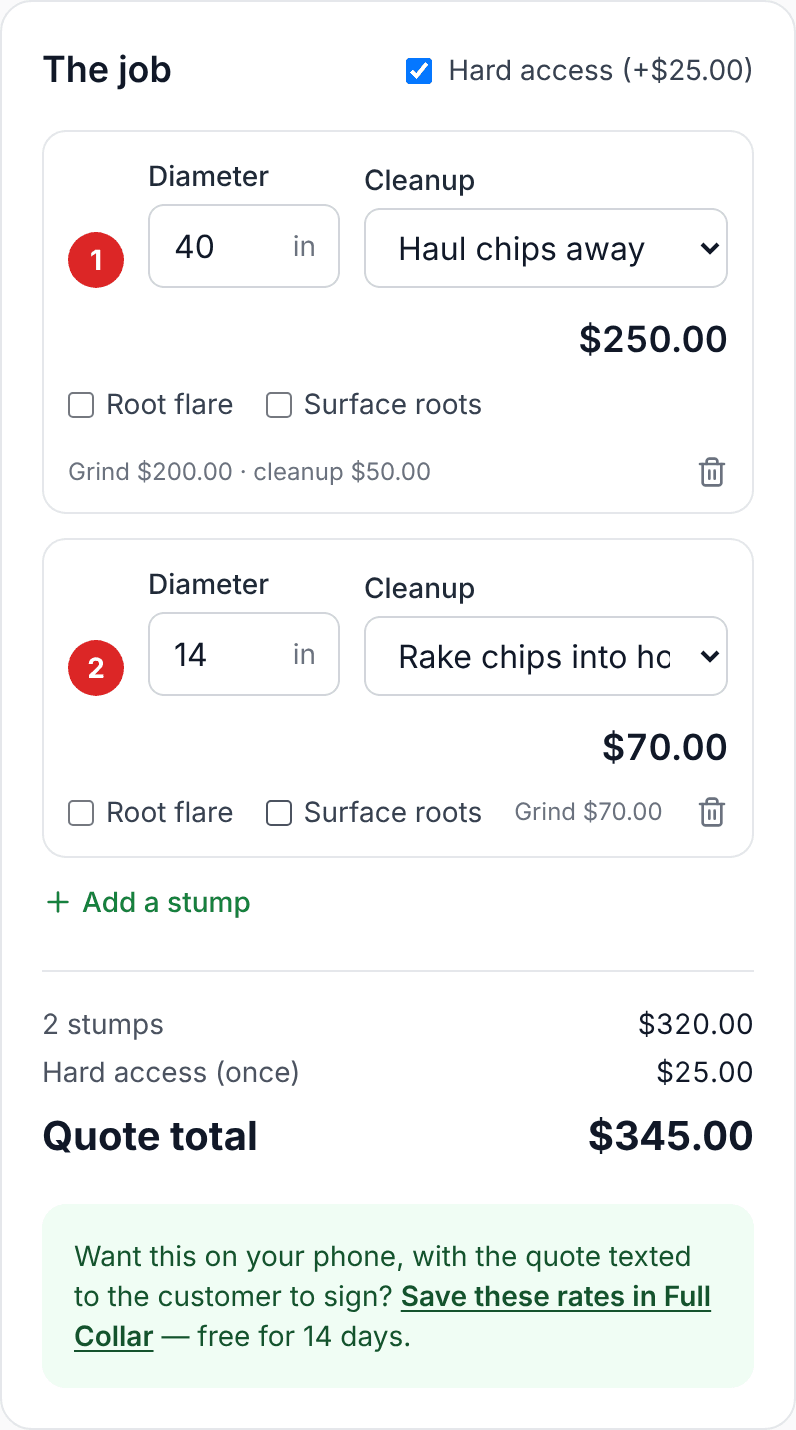
Rates: $5/inch, $150 job minimum, $50 per-stump minimum, root flare +20%, gate $25, haul-away 50% of grind.
| Stump | Grind | Add-ons | Haul (50%) | Total |
|---|---|---|---|---|
| 40″ oak, root flare | $200 | +$40 flare | +$100 | $340 |
| 14″ maple | $70 | — | +$35 | $105 |
| 6″ shoot | $50 (stump minimum) | — | +$25 | $75 |
| Gate access (once) | +$25 | $25 | ||
| Job total | $545 |
Pricing work for tree companies
If you sub for tree services, give them a lower per-inch rate in exchange for steady volume and no sales time — and bill them weekly or monthly on one statement instead of an invoice per job. Keep the job minimum, though: a single 8″ stump across the county still costs you the trip.
Quote faster, get paid faster
- Quote from the driveway: customers who get a price while you’re still there say yes more often.
- Offer two options — “grind & rake” and “grind & haul” — and let them pick.
- Number the stumps on a photo so there’s no argument about which ones were included.
- Take a deposit on big jobs and send the invoice the day the work is done.
Full Collar does this math for you: set your per-inch rate, minimums, root flare, access and cleanup (flat or percent) once, then tap in each stump’s diameter. Try the numbers first in the free stump grinding calculator, or see stump grinding software.
Set your stump rates in Full Collar and quote your next job from the driveway — free for 14 days.
Start freeQuestions
How much should I charge per inch for stump grinding?
2026 homeowner cost guides put typical stump grinding prices at $2 to $5 per inch of diameter. Where you land depends on your area, equipment, travel and competition.
What is a normal minimum charge for stump grinding?
Cost guides cite about $100 as a common minimum. Many grinders also set a smaller per-stump minimum for extra small stumps on the same job.
Should haul-away be a flat fee or based on stump size?
A flat fee is simpler; a percent of the grind price scales with the amount of chips. Guides list haul-away at about $2–$4 per inch, so a percent of a per-inch grind price tracks it well.
How much does it cost to grind a stump?
By the inch: a 12″ stump at $5 per inch is $60 and a 24″ stump is $120, but most companies have a $100–$200 job minimum, so one small stump usually costs the minimum. Extra stumps on the same visit are cheaper. See the price chart above for 6″–48″ at $3–$10 per inch.
Should access fees be charged per stump or per job?
Usually per job. The extra work is getting the machine through the gate or down the slope, which happens once whether there’s one stump or five.
Sources
More guides
- The best software for stump grinding businesses in 2026 →
- Jobber alternatives for small crews (1–5 people) →
- Jobber vs Housecall Pro for a 1–5 person business →
- Jobber pricing in 2026: what a small crew actually pays →
- The best junk removal software for small businesses in 2026 →
- The best arborist software: all-in-one platforms for tree service businesses in 2026 →